Languages
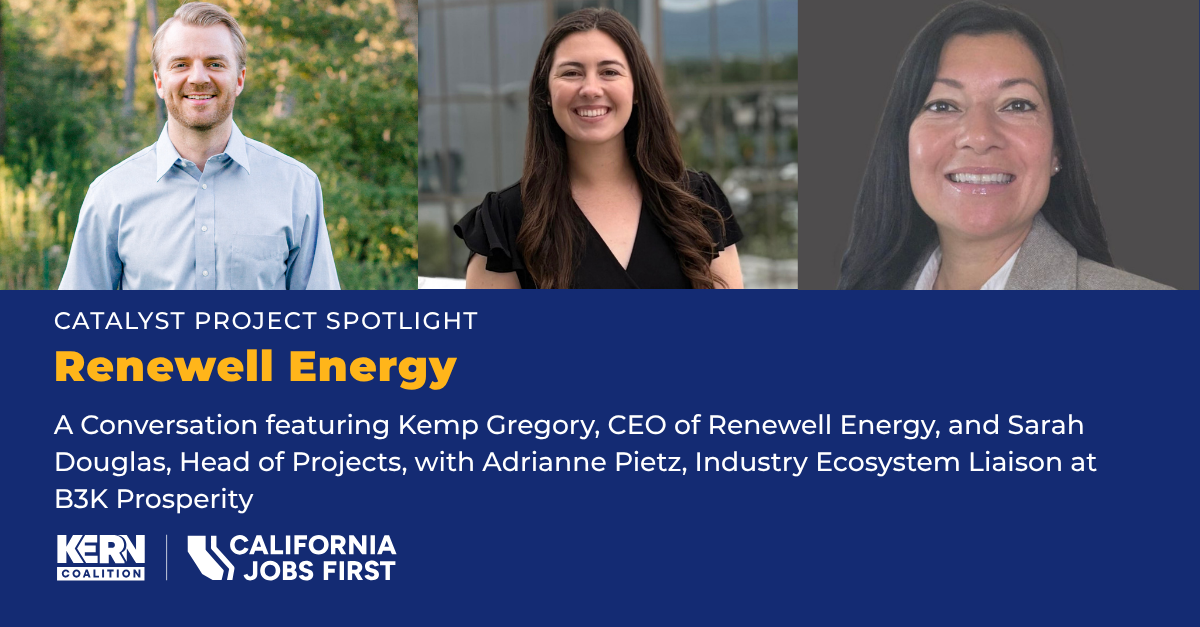
We sat down with Kemp Gregory, CEO of Renewell Energy, and Sarah Douglas, Head of Projects, to discuss how Renewell Energy is working to convert idle oil and gas wells into gravity-based energy storage systems, creating a cleaner grid and new opportunities for Kern County's legacy energy workforce. Adrianne Pietz, Industry Ecosystem Liaison at B3K Prosperity, sheds light on how B3K is supporting Renewell's visibility and community integration through the California Jobs First and theKern Coalition.
Project Snapshot
Kemp and Sarah, can you share an overview of the Renewell projects and what you're hoping to achieve?
Kemp:
Renewell's mission is to take idle oil and gas wells – of which there are millions in the United States – and convert them into gravity-based energy storage systems. The mechanics are straightforward: we move a long, dense weight up and down inside the well bore using a regenerative winch. When the weight descends, the winch pushes power to the grid. When we draw power from the grid, we reel the weight back up. Simple physics, but the implications are significant.
The energy landscape is changing fast, and that's going to impact a lot of people. Oil and gas represent about 5.5% of the U.S. workforce – comparable in scale to the entire manufacturing or construction industries. The idea that we would simply abandon those fields, level them, and pretend they never existed misses a real opportunity. Some wells need to be cleaned up, and that's fine, but others could have an entirely new life, enabling a cleaner energy future and a more resilient grid without running new power lines through people's backyards or building infrastructure nobody wants.
Let’s take a hard look at what we already have and find ways to repurpose it. That's the win-win Renewell is going after, and our two projects under the Catalyst program – Gravity and Piston – directly advance our ability to bring this to market.
Sarah:
Our Gravity Wells project is located in the Rio Bravo Field in Shafter, right in the middle of Kern County. It's a great site for us because it's already an almond orchard alongside an oil field. Reuse is already built into its identity. We're converting one of their idle wells into a gravity energy storage system, and this will be our first front-of-meter installation, which is a meaningful milestone.
Being front-of-meter means we're fully connected to the state's broader electrical infrastructure, allowing us to provide a wider range of grid services and demonstrate the full end-to-end capability of our technology. That demonstration matters because it's hard to ask companies to adopt a new solution without proof. Once we have data and a working system to point to, we can expand to other wells in that field and use it as a reference point for other oil companies across the region.
Our second project is Piston Wells. With our gravity well approach, the amount of energy we can store is constrained by well depth and straightness. When we surveyed the market, we found wells that were strong candidates for conversion but weren't ideal for the gravity well technology. The piston well technology allows us to serve those wells too, expanding our addressable market and keeping more infrastructure in use rather than idle. This Catalyst project is focused on a first-principles demonstration: we have a set of tests designed to validate the key technical concepts that would enable this second storage pathway.
Adrianne, how has B3K Prosperity been supporting Renewell's work through the Kern Coalition?
Adrianne:
Our main focus right now is getting Renewell exposure. They have a compelling demonstration project underway, and we want the right people to know about it. We recently invited Kemp to present at B3K's Advanced Energy Leadership Advisory Council (AELAC), which brings together representatives from city and county government, education, Kern CCD (Kern Community College District), CSUB (California State University, Bakersfield), California Energy Research Center (CERC), California Renewable Energy Laboratory (CREL), industry partners, labor, and engineers. Kemp gave a fantastic presentation, and I think a lot of people were genuinely surprised by the breadth of what Renewell is working on, not just in Kern, but regionally and in multiple states.
The goal is to build relationships and community buy-in early. As they move into future phases, they're going to need permitting support, workforce development partnerships, and broader stakeholder engagement. By getting them in front of the right people now, we're helping lay the groundwork so that when those needs arise, the relationships are already there.
What's the long-term vision, and what would success look like in a few years?
Kemp:
The big vision is a world where oil and gas companies, utilities, labor, and environmental NGOs all agree on something – which is admittedly a high bar – but our team achieved just that last year with SB 567. That kind of alignment doesn't happen by accident, and it told us the mission is resonating with a wide audience.
At scale, we're talking about converting hundreds of thousands of wells. There are 2 million idle oil and gas wells in the United States. Even converting 10 percent of them would be transformative, not just for the grid, but for the communities around those fields. What we're building is a world in which brownfields, rather than being abandoned or replaced by new green-field infrastructure, are rejuvenated in a way that keeps jobs, supports communities, and makes the grid far more flexible.
The energy demand increase is essentially locked in. Data centers, electric vehicles, electrification of heating – all of it is putting more pressure on a grid that hasn't needed significant additions in about 20 years. We need more infrastructure, but nobody wants new nuclear plants or new transmission lines cutting through their neighborhoods. We're over here saying: it doesn't have to be that way. Let's repurpose what's already there.
Sarah:
I want to be explicit about something we don't talk about enough when it comes to energy transition: this is a place-based solution to a place-based problem. As we shift from legacy oil and gas to emerging energy systems, there may be new jobs and new pathways – but are those pathways in the same locations? Do they use the same skills? How do we preserve hundreds of years of accumulated knowledge rather than just scrapping everything and starting over?
Because we're at idle oil wells, we're always working with local oilfield workers who don't require significant retraining. In fact, part of this Catalyst project involves evaluating exactly what transition support, if any, these workers would need to seamlessly move to our technology. In most cases, the answer is: not much. The equipment, the processes, the instincts – it's nearly a perfect overlap. Place is something the energy transition conversation tends to skip over, and we think that's a mistake.
Adrianne:
What Kemp and Sarah are building is genuinely rare. You have environmental and economic benefits, as well as workforce continuity. Idle wells that haven't been properly capped carry real environmental risk and real cost for industry and for the state. Renewell addresses that while simultaneously creating grid value. At our AELAC meeting, some of the legacy oil companies in the room started lighting up, asking whether their own idle wells could be candidates. That kind of excitement from the people who know this industry best tells you something important about where this is headed.
How is this project going to positively impact Kern County's current workforce and communities?
Kemp:
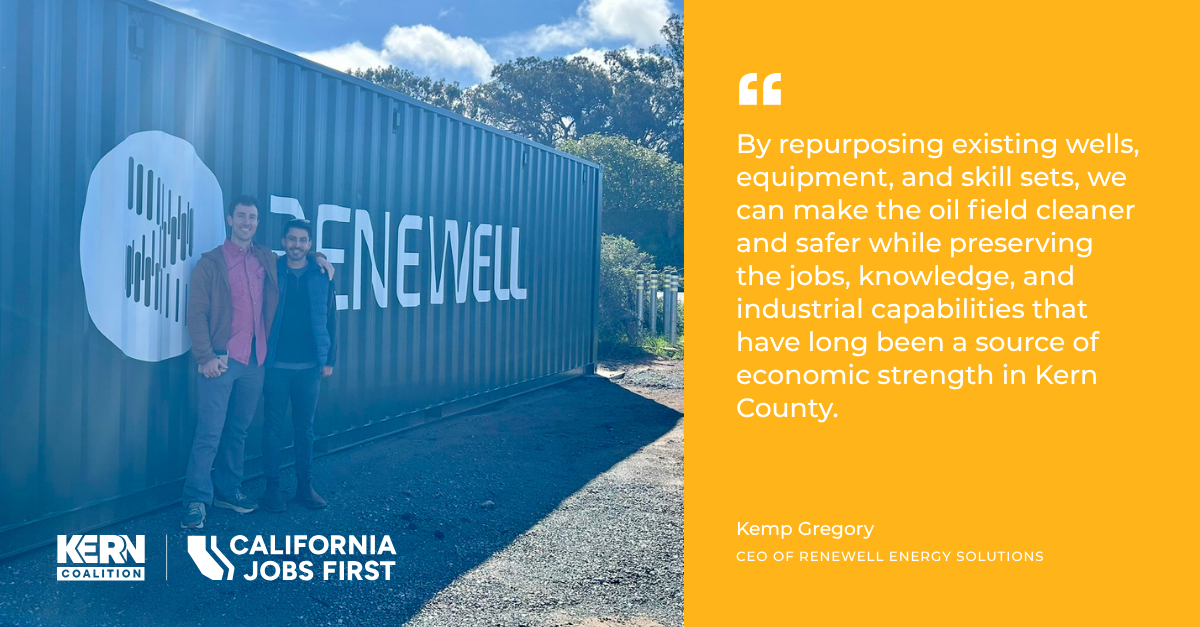
Renewell uses standard workover rigs to install our weights, so I often offer to explain the conversion process to the field crews. Often, their response is, “We’ve got it.” And they do. That experience captures one of the most important aspects of what Renewell is building. When we say that Renewell relies on the same people, processes, and equipment that have supported the oil and gas industry for decades, we mean it literally. The workforce in Kern County already possesses the skills required to deploy and operate this technology.
That is what makes this project so exciting from a community perspective. We are not asking experienced oilfield workers to reinvent themselves; we are creating new opportunities that build directly on the expertise they have spent careers developing. By repurposing existing wells, equipment, and skill sets, we can make the oil field cleaner and safer while preserving the jobs, knowledge, and industrial capabilities that have long been a source of economic strength in Kern County.
Sarah:
There are also significant supply chain effects. Over 100 hands touch each device before it's installed and operational: designers, technicians, assembly workers, truck drivers, oil field crews. The majority of those hands come through Bakersfield. This grant has helped us focus Kern County as the epicenter of our early build-out, which means local companies are becoming part of our supply chain now, as we're scaling. That's going to have second-order effects that ripple well beyond the direct jobs we create.
How can the community get involved in and support what you're doing?
Kemp:
The community has honestly already jumped in, and I find that deeply fulfilling. When we were hiring for positions in Bakersfield a few months ago, Bakersfield College (BC) was immediately there. Their industrial automation program director reached out and said, “I know exactly what you need and I want to help.” That kind of response is exactly what we're looking for more of: deeper partnerships with BC's industrial programs, closer ties with Kern CCD, and connections to talent pipelines that are already being built in this region.
Sarah:
For community members who aren't directly connected to industry or workforce programs, the most valuable thing you can do is simply be curious. We're building something genuinely new, and some of our most useful conversations have come from companies that didn't think they had anything to offer — but were willing to show up and talk about it. Be curious, not judgmental. That openness has gotten us further than almost anything else.