

Languages

We sat down with Emanuel Espinoza, owner of Lamont Auto Repair, to discuss how he's transforming a 40-year family business into Kern County's first community-based electric vehicle (EV) training and repair center with support from California Jobs First and the Kern Coalition. Bryan Osorio, Program Manager at Building Healthy Communities Kern (BHC), a Kern Coalition co-convener, shares how this project embodies the equity and environmental justice goals at the heart of the coalition's work. Together, they paint a picture of a community-rooted model that's building local talent and making clean transportation affordable in Kern County.
Project Snapshot
Emmanuel, can you introduce yourself and share what Lamont Auto Repair is hoping to achieve?
Emanuel:
Lamont Auto Repair is a family business my father opened in 1984. I took charge in 2008, and I've always looked toward the future. As California made its push toward electric vehicles by incentivizing residents to trade in older cars and get into EVs, I started seeing people in our community take advantage of those programs, but then the questions came: How do you charge it? What kind of maintenance does it need? That got me thinking. Southeast Kern has been left behind in so many ways, and I believe this is a real opportunity for our community to not just catch up, but to lead.

What are you hoping to achieve with this project?
Emanuel:
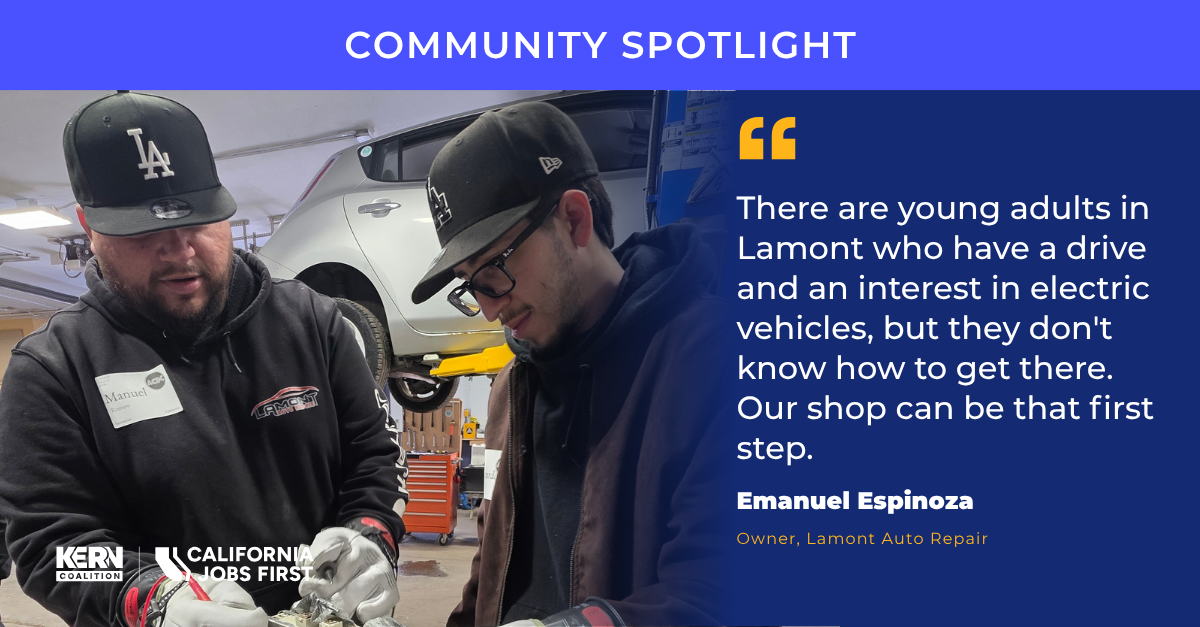
The first step is creating a repair facility that can service electric vehicles right here in the community. But ultimately, what I want to do is build a workforce. We want to be a bridge primarily for students coming right out of high school and connect them to certification programs at Bakersfield College or other vocational pathways focused on EV technology. There are young adults in Lamont who have a drive and an interest in this field, but they don't know how to get there. Our shop can be that first step.
One thing people outside of Lamont don't always see is that even transportation is a barrier. Getting from Lamont to Bakersfield College isn't always easy. When a program is practically walkable from home, that changes everything.
How is the Kern Coalition supporting this project?
Emanuel:
It's been transformational for a small shop like ours. The funding through California Jobs First and the Kern Coalition made it possible for five of my technicians to fly to Massachusetts for a two-week, intensive EV training boot camp. One of them had never been on a plane before. That's the kind of opportunity this support creates.
The program we attended, ACDC in Massachusetts, is specifically designed for shops that want to add EV services without shutting down operations. Eight hours a day of intensive training, and my guys came back energized. Right now, they're working toward their ASE certifications, the industry standard in automotive repair.

Bryan:
From visiting Lamont Auto Repair firsthand, what stands out is the depth of what they're building. By learning to repair electric vehicle batteries at the cellular level –rather than forcing a community member to pay close to, or more than, $20,000 for a full battery replacement – Lamont Auto Repair is making sustainable technology accessible and affordable for working families. That's both the clean economy piece and the economic equity piece, in practice.
This project brings world-class expertise back to Kern County and translates that investment into a local curriculum. They already have a handful of young people signed up for internships this fall, and they're building a direct, hands-on pipeline toward certification and high-quality jobs.
Why is this project important right now?
Emanuel:
We live in one of the areas with the worst air quality in the nation. That's a reality we deal with every day in Lamont. Making a real push toward EVs in our community isn't just about jobs, it's about health. It's about the environment we leave for the next generation.
From a workforce standpoint, other counties are already there. You go to LA and EVs are everywhere. Kern County is still catching up. I fully believe we're on our way, but we need infrastructure, not just charging stations, but people who know how to service these vehicles. That's what we're building.
Bryan:
When I attended a GO-Biz summit or talk with partners who are asking what a just transition actually looks like in practice, Lamont Auto Repair is the example I point to. These are technicians who have spent their careers working on oil and gas-powered vehicles. Bringing them into the next generation of vehicle repair without uprooting them, without asking them to leave their community – that's what an equitable transition looks like. The equity component behind California Jobs First and the Kern Coalition is showing up in real, tangible ways here.
How will this project positively impact Kern County communities and support economic mobility?
Emanuel:
This creates access, not just to a service that the community needs, but to a career pathway that didn't really exist here before. We're building partnerships with Arvin High School and ROC so students can start coming through our internship program early. When they leave our shop with exposure to EV technology, they're better positioned to get into a certification program, land a job, and build a real career in a growing industry.
I've always run this business to help the community, not just for profit. I grew up in Lamont. I know what it means when a community has been overlooked. I believe there is tremendous talent here, and this program is about giving that talent somewhere to go.
Bryan:
What I appreciate about Lamont Auto Repair is that they're not just thinking about Lamont. They want to offer their services across Kern County. EV dealer repairs can be prohibitively expensive and inaccessible. Affordable alternatives simply don't exist yet for most working families in the region.
By highlighting this success, Lamont Auto Repair can demonstrate that this region is positioned to attract wider workforce partnerships and infrastructure grants to scale what they're just starting. As that happens, it builds broader community comfort with electric vehicles and seeds the kind of economic transition that will play out at the local level over the coming years. The ripple effects are real.
How can the community get involved or support this work?
Emanuel:
Collaboration is everything. We want to continue building partnerships with schools, educators, other workforce programs, and community organizations. Any group that wants to give young people exposure to EVs and hybrid technology, we want to hear from them.
We want the community to see that something is being built here: for local people, by local people. I hope it encourages more interest in technical education. And I hope it opens up workforce opportunities that have historically gone somewhere else.


